
Within a few months, a new pattern has emerged in the world of AI-powered software development that has turned a trivial idea into a viral method: running a coding agent in a loop until the tests are green. Named after a character from The Simpsons, "Ralph Wiggum" represents a practice that briefly appeared on every other engineering feed and is now making the leap into productive workflows. For decision-makers in marketing, IT, and digital, the exciting question is not what the loop does technically. The exciting question is: Does this approach change the way we plan, commission, and develop custom web applications?
Our short answer: Yes, but differently than the hype suggests. The loop is not a tool that makes engineering obsolete. It is a lever that rewards requirements clarity, test discipline, and architectural hygiene to a degree that many teams have not yet achieved. Those who master these three levers can dramatically reduce the unit costs of software. Those who do not master them automate chaos.
What the technology is at its core
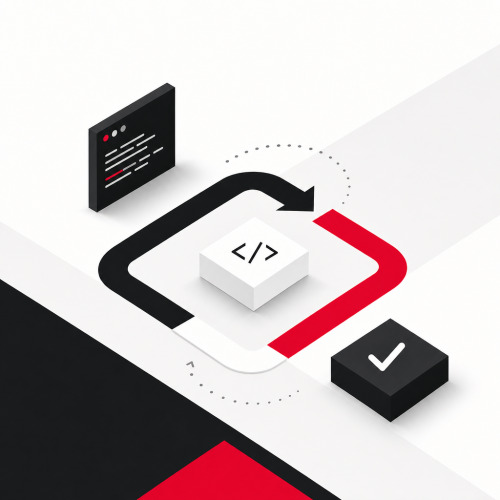
In the simplest case, Ralph is an infinite loop that repeatedly feeds the same prompt to an AI coding agent until a success criterion is met. A single line of Bash is sufficient:
while :; do cat PROMPT.md | coding-agent ; done
What is actually new is not the loop, but the discipline around it. Progress does not lie in the model's memory. It lies in the repository: in specifications, in a continuously updated plan, in tests, in Git history. Each iteration starts with a fresh context window, reads the specifications again, checks the state of things in the code, and finds the next meaningful task. When tests fail, the next agent sees the result and tries a different approach. As long as someone has defined meaningful success conditions, the system gradually moves consistently toward the goal.
The often-cited guiding principle of the approach is roughly: "deterministically bad in a non-deterministic world." Translated, this means: Models make mistakes. But if you let them work repeatedly with the same setup, you get predictable error patterns. Predictable errors can be fixed. That's precisely what makes the method productive.
Why the loop works at all
Three technical observations explain why such a simple construction delivers better results than complex multi-agent architectures.
First: Context windows are not memory. Modern models offer context windows of 200,000 tokens and more. In practice, however, output quality drops significantly once 60 to 70 percent is filled. Long sessions also create automatic context compression, where older content is summarized or discarded. The original specification is often the first to disappear. The loop circumvents the problem by building the context fresh and identically each time. What looks like waste (each iteration pays again for the same tokens) is actually the price for reliability over long runtimes.
Second: Specifications become the single source of truth. When the agent reads the specifications anew in each iteration, a pleasant side effect emerges: requirements do not shift silently into heads or tickets. They are written in black and white in the repository. This has consequences for project organization, which we will return to shortly.
Third: Tests are no longer quality assurance, but control. In the classic workflow, tests check at the end whether everything works. In a Ralph setup, tests control what the agent does next. A failing test is a control signal to the next iteration. Linters, type checkers, build systems, and security scanners become guardians that reject poor work and thus push the loop in the right direction. Those who do not have a serious test suite cannot expect anything from this mechanism.
What the method can deliver productively
The success numbers circulating in the community sound like marketing, but are partly surprisingly concrete. A frequently cited case: An order with an originally calculated volume of 50,000 US dollars was delivered using the method for around 300 US dollars in API costs, including tests and review. Another example: A team implemented six repositories overnight during a hackathon using the method. A single open-source developer built a complete programming language (compiler, standard library, LLVM backend) almost entirely in the loop over three months.
These numbers are individual cases, not benchmarks. However, they illustrate the pattern: Tasks that are mechanically verifiable and stand in a clearly defined greenfield context can be significantly accelerated. Specifically, we are thinking of:
- Migrations between framework versions (Laravel upgrades, Tailwind upgrades, API version changes across hundreds of files).
- Extensive refactorings according to a clearly defined schema.
- Building an initial product version with precise specification and complete test suite.
- Migration between languages or stacks when semantics are formally described.
What the method does not replace: architectural decisions, trade-off discussions, the definition of what "done" even means. This is precisely where the actual bottleneck of modern software projects lies, not in typing code.
The trade-offs that are not in any tutorial
Those who want to use the method productively should realistically consider several points.
Costs scale with runtime. A loop that knows no upper limit quickly burns through budget. A hard iteration limit and cost cap per run are part of a responsible setup. On numerous platforms, loops are deliberately limited to twenty or fifty iterations because an open loop can cause significant two- to three-digit euro amounts in API costs per hour. The calculation often remains attractive compared to hourly rates, but it requires active controlling.
The method is greenfield-affine. In existing, grown codebases with complex conventions, implicit architectural decisions, and historical legacy, the loop works significantly less reliably. The most common failure mode: The agent does not "find" a function and implements it a second time. Or it misunderstands an established convention. The success stories almost exclusively come from projects that start on a greenfield and in which the architecture is first created by the loop.
Specification quality becomes the bottleneck. In traditional software development, developers implicitly compensate for gaps in requirements by asking questions, guessing, or calling the client. A loop does not do this. It takes the specification literally. If the specification is contradictory or vague, the loop produces code for days that builds something other than what was intended. In our own projects, it regularly shows that a clean concept workshop at the beginning has become far more important than it was two years ago. The workshop is no longer an accessory, but a direct lever for later efficiency in the loop.
Maintainability remains an open question. Code written by an AI agent over many iterations often has a peculiar profile: clean over long stretches, occasionally surprising, in some places with constructs that humans would not have written that way. Proponents of the method argue that this does not matter because corrections run in the loop anyway. In reality, however, codebases have human readers, and they must hold up in code reviews, security audits, and when onboarding new team members. Those who run the loop without demanding consistent code quality get a special form of technical debt.
Governance and security require discipline. Loops are often operated in practice with extensive permissions. The agent may create files, execute commands, install packages, and in some setups even deploy. This is efficient, but only responsible in properly isolated environments. Containers, restricted write permissions, automated rollbacks, and a four-eyes principle before each release are not accessories, but prerequisites.
What changes practically for decision-makers
From our perspective, the loop shifts less the question "Do we still need engineering services?" than the question "For what exactly do we need it?". The answer moves up in the value chain.
Requirements become an engineering discipline. A good specification is worth more today than a fast implementation. Those who have previously assumed that "we'll clarify the exact logic during development" must relearn. In a loop-driven project, you clarify it beforehand. This shifts effort to the early phase and reduces effort in implementation.
Test suites become the product. A suite that only works in the hands of experienced developers is worthless in the loop. Tests must be so precise that an AI agent can decide whether it is done without prior knowledge. This changes the investment logic: test code itself becomes a maintainable, valuable asset, not a retrospectively added mandatory program.
Platform and architectural decisions become more sensitive. Stacks with strong static typing, clear conventions, and fast build times benefit disproportionately. For precisely this reason, we use Laravel and similarly convention-based frameworks in many of our projects: The ecosystem is well documented, conventions are explicit, and a loop can orient itself more reliably than in a thinly populated custom stack. This decision made sense before the AI wave. With the loop, it becomes a profitability factor.
Engineering roles shift. Those who work today as senior engineers spend less time typing and more with what the method does not deliver: architecture, specification, test design, code review, security assessment, trade-off decisions. Those who recognize this early and train their teams accordingly win in the new setup. Those who rely on volume engineering lose.
How we classify the approach in projects
In our own practice, we do not see the loop as a replacement for structured project work, but as an additional tool for well-defined task types. From our experience with client-funded projects, three recurring patterns emerge.
In greenfield projects with a clear domain target, the loop significantly shortens the implementation phase, especially when specifications are established early and cleanly. The saved time flows disproportionately into strategic consulting, conceptual work, and review. The project does not become cheaper in the sense of "fewer engineering days," but better in the sense of "more substance per invested day."
In migration projects and large-scale refactorings with clear mechanical patterns (such as framework upgrades, code modernizations, language migrations), the method is most productive. Here the tests exist, the success criteria are binary verifiable, and the loop can meaningfully use many iterations.
In existing codebases with grown architecture, implicit conventions, and historical compromises, we use the loop selectively and never without human reviews before each merge. This is not the area where the method shines. But it can also take on tasks here that would otherwise have remained in tickets for a long time.
Outlook
It is quite possible that the specific term "Ralph Wiggum" will be forgotten in two years and replaced by a more mature form of the same basic principle. The underlying shift remains: Coding agents are mature enough to work autonomously on clearly defined tasks for hours or days when the framework is right. The framework consists of specifications, tests, architecture, governance, and patience.
For decision-makers planning software investments in the next twelve months, it is worthwhile to actively ask three questions. First: How good is our requirements clarity, and what does it cost to bring it to a loop-capable level? Second: How seriously do we take tests as a controlling element and not just as a final quality check? Third: Which of our upcoming projects are genuine greenfield endeavors, and in which is the use of autonomous loops even worthwhile? Answers to these questions determine more about the ROI of modern software projects than the choice of the specific AI tool.
We are closely observing the development and using the method where it demonstrably creates value. At the center of our work remains the question of which architecture, which specification, and which test strategy will carry a digital product in the long term. The loop is a lever on these answers, not a replacement for them.