
Code quality determines the stability, maintainability, and future viability of digital products. Code reviews are one of the most effective tools in this regard, provided they are conducted in a structured, respectful, and goal-oriented manner. However, in practice, review processes often fail not due to technical hurdles, but due to unclear expectations, lack of communication, and misunderstood quality standards. Particularly in an era where AI-powered tools generate code at enormous speed, the ability to fundamentally evaluate code becomes a decisive differentiator.
At mindtwo, as an agency for demanding web applications and software development, we rely on clearly defined quality processes, and code reviews are a central component of them. This article shows what matters in an effective review process, which mistakes should be avoided, and how teams create a culture that sustainably ensures code quality.
Why Code Reviews Are More Than Error Control
At first glance, code reviews serve an obvious purpose: detecting errors before they reach the production environment. No double credit card charges, no database query that brings the system to its knees, no security vulnerability that exposes sensitive data. That's the foundation, but far from everything.
A structured review process accomplishes significantly more:
- Knowledge transfer within the team: Reviews create a shared understanding of the codebase. Especially when teams grow or change, institutional knowledge is easily lost. Those who regularly conduct reviews remain familiar with the architecture and design decisions of the project.
- Organic influence: Code reviews offer every team member the opportunity to help shape the direction of the codebase, regardless of formal leadership roles.
- Learning opportunity for all involved: Both reviewer and author can learn about new approaches, patterns, or framework features in a review.
- Ensuring quality and consistency: A consistent code style and uniform architectural patterns reduce cognitive load when working in a team.
Research confirms this added value. A frequently cited empirical study by McIntosh et al. in the journal Empirical Software Engineering shows that insufficiently reviewed code has a measurable negative impact on software quality in large systems. Similarly, a study published at IEEE by Kemerer and Paulk demonstrates that review speed has a measurable effect on defect detection rate: slower, more thorough reviews find significantly more defects.
An important principle applies here: Code reviews don't exist to "keep junior developers in check" or demonstrate one's own superiority. Anyone leaving 40 comments on a five-line pull request isn't practicing quality management, but ego maintenance.
Creating the Foundation: Documenting and Automating Coding Standards
Coding Standards as a Common Language
Before a single review comment is written, a team needs a common foundation: documented coding standards. They define how code is written, structured, and formatted, thereby reducing an entire class of discussions that only slow down reviews.
Developing such standards can be challenging: seven developers in a meeting, one hour of discussion, in the end seven hurt egos and zero decisions. That's why an "Informed Captain" is needed, a person who moderates discussions, brings about decisions, and casts the deciding vote in stalemate situations.
Proven approaches for developing coding standards:
- Use existing standards as a starting point: Renowned frameworks and communities offer mature standards documents. In the Laravel ecosystem, for example, there are excellent PHP and framework-specific style guides that can serve as a basis.
- Prefer framework conventions: Those who follow the conventions of the framework being used make onboarding new team members easier and improve compatibility with AI-powered development tools.
- Only document what's relevant: Not every style question needs a rule. The focus should be on decisions that affect readability, maintainability, and consistency.
We maintain our own Coding Guidelines for our projects, which serve as a binding reference for all team members, from formatting to fundamental architectural decisions.
Automation: What the Machine Can Check, It Should Check
The next logical step: enforce as many standards as possible automatically. Testing, linting, static analysis, and automated refactoring eliminate an entire category of review comments and allow the human reviewer to focus on what machines (still) cannot do: architectural decisions, business logic, and edge cases.
Recommended practice:
- CI/CD pipeline as gatekeeper: No code should reach the main branch without passing all automated checks.
- Ensure local executability: Developers should be able to run all CI checks locally, ideally via a single command. The feedback loop via the CI pipeline is significantly slower than local execution.
- Prefer dry-run mode: Instead of automatically changing and pushing code, we recommend running linters and formatters in dry-run mode. This returns control and makes changes transparent.
Standardizing the Review Process
A review process that isn't clearly defined leads to friction losses. Therefore, teams should clarify the following questions in advance:
Responsibilities and Workflows
- To whom is the review assigned? Are there fixed reviewers per team, rotation, or free choice?
- What tagging or labeling conventions apply? T-shirt sizes for scope, team assignments, priorities.
- How is the integration with the ticketing system? The link between pull request and ticket (Jira, Linear, ClickUp) creates traceability and context.
PR Size and Turnaround Time
Small pull requests are better pull requests. People, like AI models, have a limited context window. Thoroughly reviewing a 2,000-line diff is practically impossible. Review quality decreases proportionally to PR size.
A proven model for larger features follows the principle of nested deployments: first the isolated core that doesn't touch anything existing. Then the integration, protected by feature flags. And finally the activation: the route, the controller, removing the flag.
Equally important: Clear expectations for processing time. When a pull request remains unprocessed for days, context loss and frustration occur. An explicit agreement, such as "Review within four hours," creates accountability.
PR Templates: Less Is More
Many teams use elaborate PR templates with dozens of checkboxes and subheadings. In practice, they aren't filled out by the author and aren't read by the reviewer. A concise template with three core questions suffices:
- What does this PR do? Brief description of the change.
- What risks exist and how were they minimized? Awareness of side effects.
- How was it tested? Proof of functionality (ideally with screen recording or test script).
Responsibilities: What Author and Reviewer Must Deliver
The Author's Duties
Read your own code. What sounds obvious is no longer so in the era of generative AI. Submitting code that no one has read to a colleague for review is disrespectful and counterproductive. Anyone submitting code must have understood it.
Furthermore:
- CI pipeline must be green before requesting the review. Failed pipelines, whether due to real errors or flaky tests, tie the reviewer's attention to the wrong place.
- Fill out PR description: The few fields in the template deserve careful completion.
- Attach screen recordings: A short video testing the API endpoint or demonstrating the migration creates trust and context.
- Provide instructions for local testing: A tinker script, factory calls, or test data, anything that makes it easier for the reviewer to get started.
- Link ticket: The connection to the issue in the ticketing system is essential for context.
Use draft PRs as a tool: The GitHub or GitLab diff view activates a different cognitive perspective than the IDE. Many developers only discover errors when they see their code in diff format, similar to typos that only become apparent after sending an email. Draft PRs enable this self-review before colleagues are involved.
The Reviewer's Duties
Read the ticket. Ticketing systems are the intersection where development, product management, and design converge. Without knowledge of the ticket, the reviewer lacks context for evaluation: Why is this change being made? What problem does it solve? What are the acceptance criteria?
If the ticket is insufficiently documented, it's legitimate and important to ask for clarification. A ticket with the title "Refactor XYZ Service" and the body "Reduce" is not an adequate basis for a review.
Read the PR description. Here too: if the template was filled out, it deserves attention.
Check out code locally when possible. This is an underestimated tool. Local execution enables:
- Verification that the code runs (not just that it "looks good").
- Verification of correctness against requirements.
- Active search for edge cases, the most difficult but most valuable part of any review.
Tools like Telescope in Laravel projects make problems visible that remain invisible in the code diff: 500 queries on an endpoint, 300 of them duplicates—no static review catches that.
Take your time. A review under time pressure is a poor review. Teams should explicitly schedule time blocks for reviews instead of squeezing them between other tasks. If a PR is too large for a thorough review, the reviewer should not write "LGTM" but ask the author to split the PR.
Communication in Reviews: The Underestimated Core Competency
Clear Comments Instead of Vague Hints
Vague comments like "This should be different" create frustration and follow-up questions. Every review comment should contain two elements:
- A clear statement of what should be changed.
- The reasoning for why this change makes sense.
Without reasoning, the author can neither understand nor internalize the recommendation. The result: the same patterns reappear in the next PR.
Conventional Comments: Structure for Review Feedback
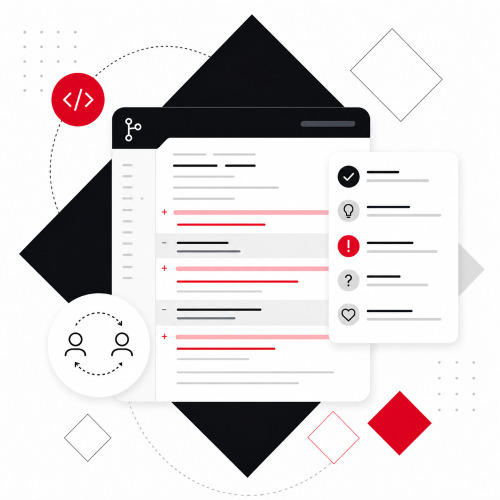
A proven system for structured review comments is Conventional Comments. They add a label to each comment that classifies the type and urgency:
- praise: Recognition for well-written code
- suggestion (non-blocking): Improvement suggestion that doesn't block approval
- issue (blocking): Problem that must be resolved before merging
- question: Question for understanding
- thought: Consideration or impulse without direct call to action
The added value of this system is multi-layered: It forces the reviewer to think about the nature of their feedback before sending it. In practice, this leads to many comments not being written at all because the reviewer recognizes that it's just a personal style preference, not a real issue.
The distinction between blocking and non-blocking is particularly valuable. It gives the author clarity about which comments must be addressed and which are to be understood as suggestions. This significantly reduces unnecessary feedback loops.
Use Language Consciously
A subtle but effective shift: Instead of "You forgot ..." or "You should ..." experienced reviewers formulate in the we-form or refer to the code instead of the person. "We should here ..." or "The code should ...": This linguistic shift fundamentally changes the dynamics. Reviews become collaborative work on a product instead of personal criticism.
Don't Forget Praise
Positive comments are not a nice-to-have. They are essential for a healthy review culture. When a colleague chooses an elegant solution approach, skillfully uses a framework feature, or adopts a recommendation from a previous review, that deserves recognition. It signals: I didn't just search your code for errors, but also understood and appreciated it.
Nitpicking: The Line Between Consistency and Control
Style questions that aren't recorded in the documented standards don't belong in a code review. Whether someone prefers collections or array_* functions is, as long as the result is correct and readable, a question of personal craftsmanship. The willingness to accept different solution approaches is a sign of maturity in the review process.
The rule of thumb: "Don't trample over good enough while searching for perfect." Software is soft, code can be iteratively improved after merging. The pursuit of perfection must not block a product's progress.
Don't Change the Other's Code
One of the most important rules in the review process: Reviewers don't change the author's code. What may seem pragmatic undermines trust and personal responsibility. It leads to rebasing conflicts, uncertainty ("Are you done with my code?"), and dynamics that relegate the author to passive observer.
Instead, there are better alternatives:
- Suggestions in GitHub/GitLab: The reviewer proposes concrete code changes that the author can adopt with one click.
- Offer pairing: For more complex topics, a 15-minute joint walkthrough of the code is more effective than ten asynchronous comments.
Code Reviews in the Age of AI-Generated Code
The ability to generate code has never been as accessible as it is today. LLM-based tools produce working code in seconds. But that's exactly what makes code reviews more important than ever.
Current studies show a nuanced picture: An analysis from CodeRabbit's "State of AI vs Human Code Generation" report (December 2025), which examined 470 real GitHub pull requests, concludes that AI-generated code has about 1.7 times more issues than human-written code. In detail: logic and correctness errors occur 75 percent more frequently, readability problems triple, security vulnerabilities increase by a factor of 1.5 to 2. In the area of security, independent studies also show persistent weaknesses: while newer LLMs generate syntactically more correct code, they still produce recurring vulnerability patterns such as insecure object references or faulty password handling.
Strategies for Reviewing AI-Generated Code
The review process for AI-generated code isn't fundamentally different, but discipline must be higher:
- Good tickets as foundation: A ticket with clear description, acceptance criteria, and given-when-then scenarios serves not only the human developer as a briefing, but also as an effective prompt for AI agents.
- Generate small units: Instead of having an entire feature generated by AI, the work should be broken down into small, manageable parts. Each generated commit is treated and reviewed like its own PR.
- Don't let it run too far ahead: The more code an AI agent produces without human control, the more difficult subsequent correction becomes. Regular checkpoints prevent errors from cascading.
- Understand code, don't just accept it: The fundamental duty remains: anyone submitting code must have read and understood it, regardless of whether they wrote it themselves or had it generated by AI.
Use AI-Powered Review Tools Strategically
In addition to manual review, AI-based review tools offer an additional quality layer. Tools like GitHub Copilot Code Review, CodeRabbit, or Cursor's BugBot analyze pull requests automatically and leave comments.
The added value lies primarily in two areas:
- Rule-based checks beyond CI: Some quality requirements cannot be translated into linting rules or static analysis. Example: "If a new test doesn't use framework features, it should be implemented as a pure unit test." Such context-dependent recommendations can be configured as rules in AI review tools.
- Consistent coverage: AI review tools don't get tired, don't overlook obvious patterns, and don't forget rules. They complement human review but don't replace it.
Important here: Configuring these tools requires care. Each tool works differently, and unconfigured AI reviews produce as much noise as value.
The Organizational Dimension: Clarity from Above
A frequently overlooked aspect: the review process must align with the organization's priorities. A bootstrap startup with two developers and a month of runway uses code reviews differently than a mature product with a hundred developers, of which only two remain at the company.
It's worth explicitly clarifying:
- What is the goal of our reviews? Hardening the product or fast feature delivery, or a combination?
- How much review effort is appropriate? The answer varies depending on risk tolerance, team size, and product maturity.
- Who defines the process? Non-technical leaders typically formulate "correct and fast." It's up to engineering to translate that into a workable process.
This alignment with the organization is part of the strategic consulting that we at mindtwo understand as an integral part of our project work: setting up processes and tooling so they fit the team structure and business goals.
Code Reviews as Learning Culture
A final, often underestimated aspect: code reviews are one of the best opportunities for organic learning in development teams. Sometimes you hear that the worst time to teach is during code review. This statement deserves objection. The worst time is never. The second worst is during an incident postmortem.
In reviews, architectural decisions can be explained, patterns conveyed, and framework knowledge shared in a concrete, practice-oriented context. When the reviewer provides reasoning for their recommendation, knowledge transfer occurs that has an impact beyond the individual PR.
Quality as a Competitive Advantage
Code quality is not an end in itself. It's a measurable business factor: fewer outages, faster bug fixes, more efficient onboarding of new team members, higher development speed with growing complexity.
In an environment where products are cloned faster than ever before, the quality of the codebase and the team's knowledge about this codebase become the decisive differentiator. This knowledge cannot be copied. It emerges through daily practice: through reading, understanding, and evaluating code as a team.
Code reviews are not bureaucratic overhead. They are an investment in the resilience and evolvability of digital products. Those who structure this process in a structured, respectful, and goal-oriented manner not only build better software, but also better teams.
Are you considering how to structure code quality and review processes more systematically in your team? Contact us. We'll support you in developing workflows, tooling, and standards that fit your team size and business goals.
Further Resources
- Conventional Comments — Structured labeling system for review comments
- McIntosh et al. (2016): An Empirical Study of the Impact of Modern Code Review Practices on Software Quality — Empirical study on the relationship between review quality and software quality (Empirical Software Engineering)
- Kemerer & Paulk (2009): The Impact of Design and Code Reviews on Software Quality — IEEE study on review speed and defect detection
- CodeRabbit (2025): State of AI vs Human Code Generation Report — Analysis of defect rates in AI-generated code