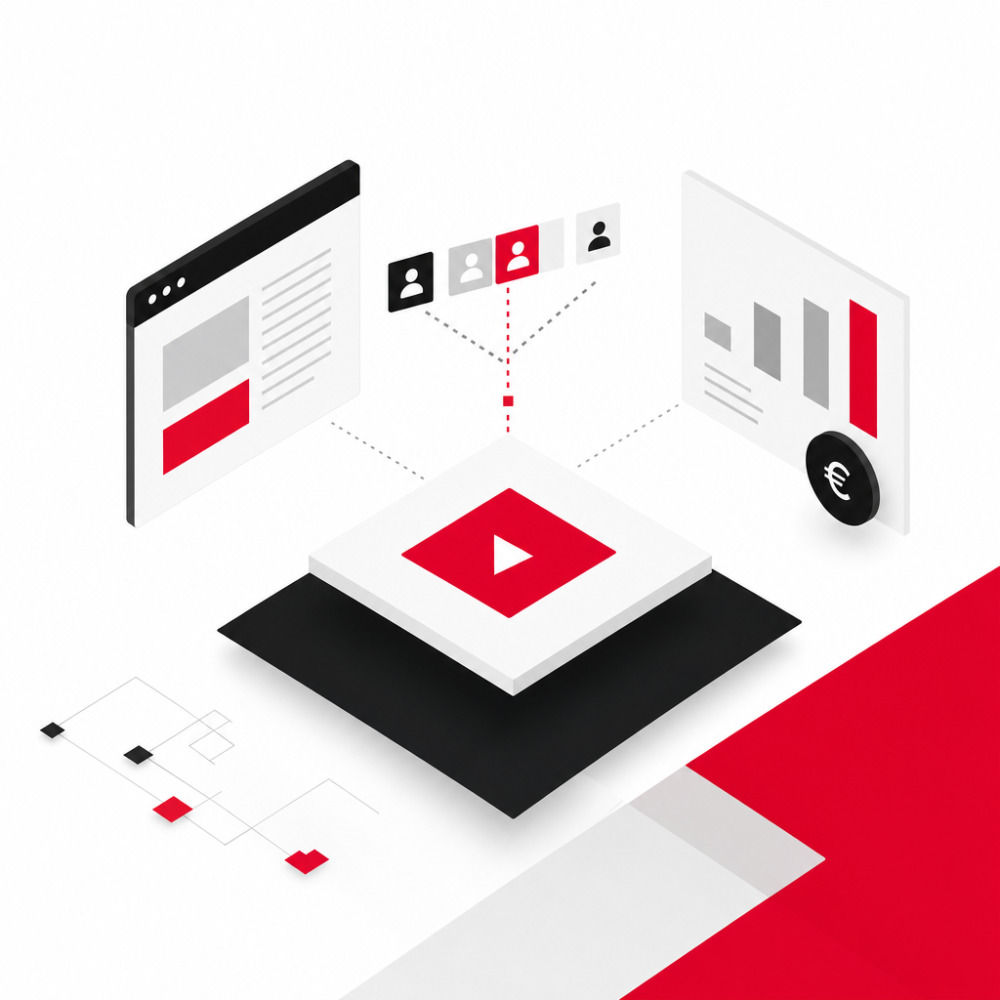

Programmatic Advertising automates the purchase of digital advertising space in real time. Instead of manual media booking, algorithms decide who sees which ad at what price. Those who set the fundamentals correctly benefit from more precise targeting and significantly more efficient budget allocation.
For companies that want to use digital advertising channels strategically, Programmatic Advertising is an important component in Performance Marketing, but not a cure-all. This article provides the briefing that marketing managers need to make informed decisions.
What is Programmatic Advertising: Definition and Core Concept in One Minute?
Programmatic Advertising refers to the fully automated, data-driven buying and selling of digital advertising space. Instead of a media planner manually booking ad placements, a technological infrastructure takes over this process, in real time, based on user data and via an auction system.
What makes it special is that you don't buy the advertising space, but the impression, i.e. the specific moment when a particular user calls up a particular page. This makes Programmatic Advertising one of the most precise targeting instruments in digital marketing.
What is Programmatic Advertising? Programmatic Advertising is the automated, algorithm-driven buying and selling of digital advertising space in real time. Advertisers don't buy fixed ad placements, but impressions with defined target groups, based on user data, contextual signals and automated auctions.
What distinguishes Programmatic from classic automated display advertising?
Display advertising in the classic sense meant that a media planner manually books an ad on a specific website, with a fixed duration, fixed price and fixed placement. Programmatic Advertising goes far beyond that. Here you don't book space, but address a target group. Algorithms take this over on thousands of websites simultaneously, in milliseconds.
| Feature | Classic Display Booking | Programmatic Advertising |
|---|---|---|
| Booking process | Manual, directly with publisher | Automated via technological platforms |
| Targeting | Context-based, rough | User data-based, very precise |
| Pricing model | Fixed price, negotiated | Real-time auction, dynamic |
| Reach | One publisher, defined spaces | Thousands of publishers simultaneously |
| Adjustment | Barely during the campaign | Continuous, in real time |
| Entry barrier | Low | Medium, technical setup required |
How does Programmatic Advertising work: DSP, SSP and Auction?
Behind the term Programmatic Advertising is an ecosystem of different platforms that work together. The two central players are the Demand-Side Platform (DSP) on the advertiser's side and the Supply-Side Platform (SSP) on the publisher's side.
What is a DSP and what role does it play for advertisers?
A Demand-Side Platform (DSP) is the technological platform through which advertisers purchase programmatic advertising space. It aggregates inventory from various sources (ad exchanges, publisher networks and private marketplaces) and enables centralized control of target groups, budgets, bidding strategies and creatives.
Well-known DSPs include Google Display & Video 360, The Trade Desk or Amazon DSP. The DSP is the control center for advertisers. Here you define who you want to address, what an impression may cost at most and which ads you want to display.
What is an SSP and what does it bring publishers?
A Supply-Side Platform (SSP) is the opposite side. Publishers use it to automatically sell their advertising inventory to advertisers at the highest possible price. The SSP connects the publisher with multiple ad exchanges simultaneously, thus maximizing revenue per impression through competition between different bidders.
| Player | Role | Perspective |
|---|---|---|
| Advertiser | Buys impressions with target groups | Wants to reach the right users cheaply |
| DSP | Advertiser's technology platform | Controls bids, targeting, creatives |
| Ad Exchange | Marketplace, connects DSP and SSP | Enables the auction |
| SSP | Publisher's technology platform | Maximizes revenue from inventory |
| Publisher | Sells advertising space on their website | Wants highest price for their users |
What happens in an RTB auction and how fast?
When a user visits a website, a complete auction runs in the background within 50 to 100 milliseconds. The principle is called Real-Time Bidding:
- The user's browser loads the page and transmits anonymized user data to the SSP
- The SSP forwards a bid request to relevant DSPs
- Each DSP calculates how much this impression is worth based on its targeting parameters
- The highest bid wins: The system delivers the corresponding ad
- The user sees the page fully loaded, the ad appears without noticeable delay
This process happens billions of times daily, fully automated and without human intervention.
What can Programmatic Advertising do and what can't it do?
Programmatic Advertising is a powerful instrument. But it also has structural limitations that marketing managers should know. Otherwise, false expectations arise.
When is Automated Advertising superior to classic channels?
Automated Advertising is particularly strong when you need both large reach and precise targeting simultaneously. Classic channels quickly reach their limits here. Either you reach many people unspecifically or book specific environments manually with high effort.
- Reach with specific target group: Programmatic reaches defined user segments on thousands of websites simultaneously, without booking each publisher individually.
- Efficiency through real-time optimization: The system automatically shifts budgets to the best-performing placements, in real time, without manual intervention.
- Cross-channel delivery: Display, video, native, audio and connected TV are controlled via a single DSP.
- Data-driven targeting: First-party data, retargeting lists and lookalike audiences are used directly for precise targeting.
Where does Programmatic Advertising structurally reach its limits?
- Transparency: In the open exchange, it's often unclear on which exact placements an ad appears. Brand safety is a real risk that you must actively manage.
- Complexity: A professional setup requires technical know-how. DSP configuration, audience building, frequency capping and creative requirements need to be well thought out.
- Minimum budgets: Below a certain budget, the ROI of Programmatic Advertising is limited because the technical and operational effort consumes the scaling advantages.
- Data protection: With the end of third-party cookies, targeting is fundamentally changing. Those who don't have their own first-party data strategy lose reach.
| Aspect | Strength | Limitation |
|---|---|---|
| Targeting | Very precise, data-based | Dependent on data availability and data protection |
| Reach | Very large, cross-channel | Open exchange carries brand safety risks |
| Efficiency | Real-time optimization, no manual effort | Requires monitoring and quality control |
| Entry | Scalable from small to large | Technical setup and know-how required |
| Transparency | Detailed reporting possible | Placement transparency in open exchange limited |
For whom is Programmatic Advertising worthwhile: concrete guidance?
Whether Programmatic Advertising is suitable depends primarily on objective, budget and data basis. Not every company benefits equally. Those who bring the wrong expectations will be disappointed.
From what budget is Programmatic Advertising sensibly usable?
Below 2,000 to 3,000 € monthly media budget, the effort for setup, management and optimization is usually not economically viable. From 5,000 € monthly you can sensibly operate a professional programmatic campaign, with sufficient data volume for algorithms and optimization potential.
This applies to entering the open exchange. Private marketplace deals or specific premium inventories usually require higher minimum budgets.
| Company Type | Budget | Objective | Suitability |
|---|---|---|---|
| E-commerce | From 3,000 €/month | Retargeting, new customer acquisition | ✅ Very well suited |
| B2C brand | From 5,000 €/month | Awareness, reach | ✅ Well suited |
| B2B with niche target group | From 5,000 €/month | Awareness, remarketing | ⚠️ Limited, target group often too small |
| Local SME | Under 2,000 €/month | Local visibility | ❌ Usually not economical |
| Lead gen with long cycle | Variable | Nurturing, retargeting | ⚠️ Limited, highly dependent on data basis |
| App marketing | From 3,000 €/month | Installs, engagement | ✅ Well suited |
For companies that want to use Programmatic Advertising as part of a larger digital advertising mix, consultation from an experienced SEA agency is recommended, because programmatic and search advertising complement each other very effectively in a full-funnel setup.
What does Programmatic Advertising cost and which KPIs count?
Programmatic Advertising is typically billed by advertisers according to CPM (Cost per Mille), i.e. the price per 1,000 impressions delivered. Depending on inventory quality, targeting precision and channel, CPMs vary considerably.
Typical CPM benchmarks in the German market:
| Inventory Type | Typical CPM | Particularity |
|---|---|---|
| Open exchange display | 0.50 to 2.00 € | Cheap, but variable quality |
| Private marketplace display | 2.00 to 8.00 € | Better brand safety, defined publishers |
| Video (pre-roll) | 5.00 to 15.00 € | High attention, higher price |
| Connected TV | 10.00 to 25.00 € | Premium inventory, growing segment |
| Native advertising | 1.00 to 5.00 € | High relevance, less disruptive |
| Audio (streaming) | 3.00 to 8.00 € | Growing segment, little competition |
CPM, CPC, CTR, ROAS: What is really meaningful for Programmatic?
A common mistake is to evaluate Programmatic Advertising with CTR (click-through rate). Programmatic is primarily a reach and awareness channel. Clicks are often not the primary goal, and a low CTR does not automatically mean poor performance.
The most meaningful KPIs depend on the campaign objective:
| KPI | Meaning | When relevant |
|---|---|---|
| CPM | Cost per 1,000 impressions | Always, efficiency benchmark |
| Viewability rate | Share of actually seen impressions | Mandatory, min. 50% visible for 1 sec. |
| Brand safety score | Share of problematic placements | Mandatory, monitor continuously |
| Frequency | Avg. contacts per user | Important, avoid over-exposure |
| View-through conversion | Conversions after ad view (without click) | For awareness campaigns |
| ROAS | Revenue per advertising € spent | For conversion-oriented campaigns |
Programmatic Advertising in the Media Mix: How does it fit in?
Programmatic Advertising doesn't replace other digital channels. It complements them. In a full-funnel setup, it primarily covers the upper and middle part of the customer journey. It creates awareness, arouses interest and addresses users again.
Search advertising (SEA), on the other hand, intervenes at the lower end of the funnel, when users are already actively searching for a solution. Both channels together cover the entire journey. Programmatic builds awareness, SEA converts the generated demand. How a holistic approach meaningfully combines both channels is described in our article on holistic marketing.
What the optimal combination of programmatic, SEA and other channels looks like for your specific objective depends on budget, target group and funnel structure. This is best clarified in direct conversation.
Conclusion
Programmatic Advertising is one of the most powerful instruments in online marketing when you use it correctly. It offers precise targeting, cross-channel reach and real-time optimization that manual booking processes cannot structurally achieve.
At the same time, it's not a self-starter. Those who enter Programmatic Advertising without sufficient budget, without a clear objective definition or without a data basis will not exploit the strengths of the channel. The basic prerequisites must be right. Then Automated Advertising is one of the most efficient ways to build digital reach in a targeted manner.
Do you want to know if and how Programmatic Advertising fits into your media mix? We'd be happy to talk about it, in a free initial consultation, non-binding and directly related to your objectives and budget.